
Product Categories
PRODUCT CATEGORYContact Us
CONTACT USMobile phone:+86-15395152932
mail:sale@assyauto.com
Address:Electronic Information Industrial Park, Shunyi District, Beijing City
Gas Stove Assembly Line
I. Overview The domestic household gas stove industry has entered a stage where standardize...
Details
I. Overview
The domestic household gas stove industry has entered a stage where standardized mass production coexists with flexible customization. The complete assembly of a single stove involves dozens of components — valve bodies, igniters, burners, pan supports, panels, gas pipes, and more. The processes are dispersed and involve numerous assembly actions, making it difficult to completely avoid quality defects such as missing parts, substandard tightening torque, and missed air-tightness inspections when workers operate independently. The traditional fixed-workbench production model has obvious capacity bottlenecks, and production data cannot be traced in real time, making it difficult to meet the mandatory national-standard inspection requirements for gas appliance factory acceptance.
The gas stove assembly line (gas stove production line) is complete-unit assembly equipment developed specifically for automated kitchen appliance production. It adopts a speed chain conveying structure as its main body, equipped with workstation industrial control systems, pneumatic tightening units, and air-tightness testing modules, connecting component pre-assembly, complete-unit assembly, and off-line inspection into one continuous production flow.
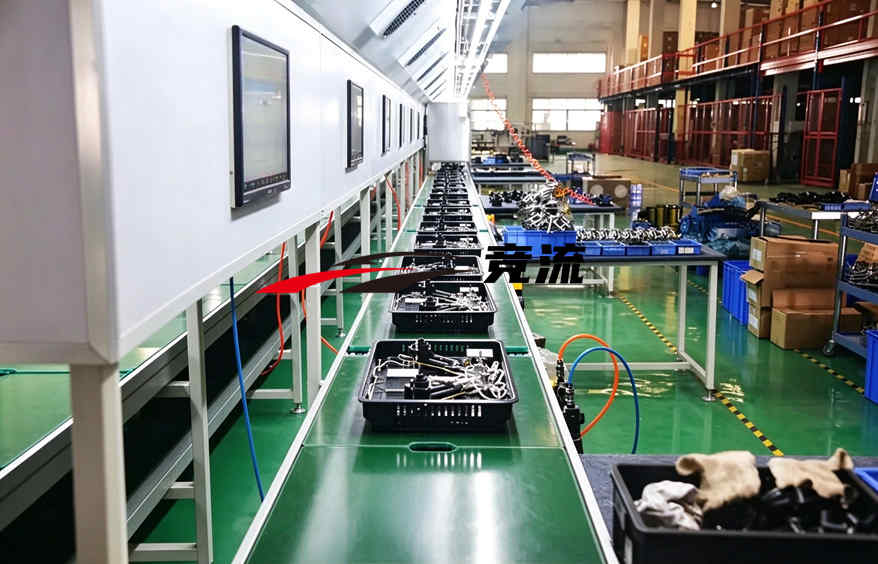
The complete gas stove production line uses pallets as carriers, with stove semi-finished products fixed onto work pallets and conveyed along the line to each assembly workstation. The line integrates MES interface connections, and workstation touchscreens push work instructions and record assembly parameters in real time. The tightening torque and air-tightness test results of each product are bound to a product serial number, enabling full life-cycle traceability. This gas stove assembly conveyor line adapts to changeover production of multiple product types including built-in stoves, freestanding gas stoves, and high-power commercial stoves, meeting multi-model mixed-line production through rapid fixture switching. It is widely used in new production line construction for kitchen appliance manufacturing plants and in automation retrofitting of old manual lines, effectively reducing human assembly errors, improving finished-product pass rates, stabilizing production takt, and releasing workshop floor utilization.
II. Assembly Process
The gas stove assembly line is segmented according to stove assembly logic into pre-assembly workstations, main assembly workstations, performance inspection workstations, and off-line sorting workstations, with process flow sequence aligned one-to-one with the stove assembly process route.
- Component pre-assembly workstation: completes pre-assembly of valve body assemblies, ignition needles, and gas delivery pipes; materials are placed in workstation material boxes, and the line’s traveling tooling positions parts to prevent misplacement.
- Complete-unit assembly workstation: equipped with pneumatic tightening tools, tool hangers, and air source piping, completing burner installation, panel fixation, and pipeline connection; the system features process interlock — if the previous workstation is incomplete, line flow is blocked, preventing missed processes at the source.
- Air-tightness inspection workstation: the gas stove production line incorporates an air-tightness test module that performs pressure-holding leak testing on the stove gas circuit, automatically determining pass/fail; rejected products are interlocked on the line and prevented from flowing to the next process.
- Powered ignition test workstation: completes ignition performance and flame state testing, collecting product test data and uploading it to the system.
- Sorting and off-line workstation: qualified products automatically flow to the packaging area, while defective products are separately diverted for repair.
The complete process integrates manual assembly, automated inspection, and data collection, addressing the most critical air-tightness safety control pain point in gas stove production. All inspection data is retained and archived, meeting quality inspection and factory audit requirements for the gas appliance industry.
III. Customizable Parameters
The main structure and functional modules of the gas stove assembly line can all be customized according to customer factory dimensions, product specifications, and target takt. Key customizable items are as follows:
- Line conveying mode: speed chain conveying as standard, with optional flat-top chain or belt conveying; line length and workstation count are designed according to capacity requirements; single-workstation takt customizable from 80 to 180 seconds/unit.
- Work pallets: custom fixture design based on stove configuration, supporting rapid mold change, compatible with mixed production of freestanding and built-in stoves; pallets feature built-in locating pins to ensure repeat positioning accuracy during assembly.
- Electrical control and data system: standard workstation touchscreens, connectable to factory MES systems for production data collection, process error-proofing, and product traceability; optional audible/visual alarms and material shortage alerts.
- Integrated functional modules: optional auto-tightening units, air-tightness testers, ignition test benches, barcode scanners, and defective-product diverting mechanisms; air and power lines are integrated into routed cable trays for a clean, standardized workshop layout.
- Structure and environment adaptation: line frames available in aluminum profile or carbon steel powder-coated; adjustable floor support feet to accommodate workshop floor level differences; anti-static work surfaces supported to meet anti-static requirements for kitchen appliance assembly.
- Auxiliary support: available online material racks, tool suspension systems, and parts turnover bins, with synchronized planning of workshop material delivery channels.
The gas stove production line is not a standardized universal flow line — its design must be based on the customer’s product models, capacity targets, factory length/width/height, and existing quality inspection specifications. A customized gas stove assembly line can maximize the reduction of ineffective transfer time, stabilize product quality, and help kitchen appliance enterprises achieve scaled, standardized gas stove production.
Gas Stove Assembly LineQuote----Gas Stove Assembly LineFor the latest case images, please contact us for more specific information