Product Categories
PRODUCT CATEGORYContact Us
CONTACT USMobile phone:+86-15395152932
mail:sale@assyauto.com
Address:Electronic Information Industrial Park, Shunyi District, Beijing City
Lightweight laptop assembly line occupies less space
Laptop Assembly Line Precision Engineering for Portable Computing at Scale
The Production Landscape
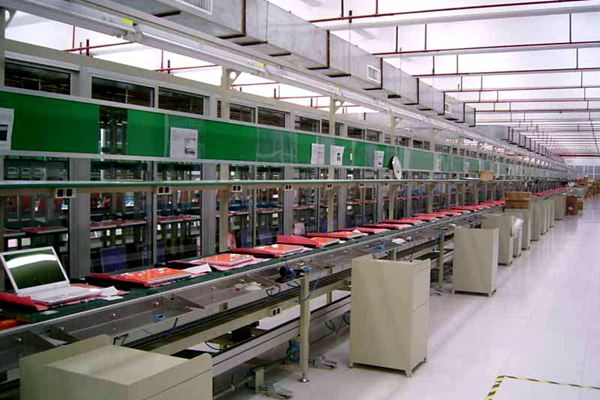
The image captures a large-scale laptop assembly line—a high-density manufacturing ecosystem engineered for the relentless pace of global consumer electronics. This facility is not merely a production floor; it is a physical manifestation of systematic precision, where hundreds of sequential operations converge to transform individual components into portable computing platforms.
Unlike general electronics assembly, this line is architected for the specific constraints of notebook manufacturing: extreme compactness, fragile interconnects, and the absolute necessity of aesthetic perfection. It represents the standard employed by leading OEMs and EMS providers, balancing high-volume throughput with the zero-defect tolerance demanded by worldwide markets.
I. The Linear Spine: Extended Configuration
The defining characteristic of this facility is its extended linear conveyor configuration. Stretching deep into the production hall, the line creates a continuous flow of units progressing through dozens of specialized stations.
Climate-Controlled Integrity
Overhead, extensive HVAC ducting maintains a rigorously controlled environment. Precise regulation of temperature and humidity is not optional—it is a prerequisite for preventing moisture-related defects in sensitive semiconductors and ensuring the reliability of adhesive bonding processes. This invisible layer of environmental control underpins the entire operation.
Ergonomic Flow
The elevated conveyor system, utilizing integrated belts or rollers, ensures smooth, consistent transitions between stations. By maintaining an optimal working height, the design mitigates operator fatigue during long shifts. The sheer scale of the line, visible in its receding perspective, underscores its capacity to serve both consumer and enterprise markets on a global scale.
II. Micro-Ergonomics: The Workstation Ecosystem
Given the miniature scale of laptop internals, workstation design shifts from general ergonomics to micro-precision.
Surface Protection
Standardized work surfaces are complemented by distinctive colored protective mats. These serve a dual purpose: providing cushioning to prevent microscopic damage to delicate aluminum or composite housings and offering visual cues for process segmentation.
Visual Management
Green partition panels between stations create semi-enclosed environments, reducing visual distractions and allowing operators to maintain intense focus on intricate tasks, such as routing ribbon cables or seating micro-connectors. Overhead lighting arrays are calibrated to eliminate shadows within the deep recesses of a laptop chassis.
Reach Optimization
Tools, fixtures, and component bins are positioned within the operator’s natural reach envelope. This meticulous layout minimizes non-value-added motion, ensuring that the physical act of assembly does not introduce variability into the process.
III. The Build Sequence: Miniaturization Under Pressure
The assembly process is a masterclass in spatial efficiency, transforming a flat chassis into a fully functional computer.
- Foundation & Core: Bottom chassis preparation leads to the integration of the Mainboard (CPU/Chipset), memory modules, and SSDs.
- Display Integration: Dedicated stations handle the delicate marriage of the LCD/OLED panel. Technicians carefully route fragile flex cables and install hinge mechanisms—the mechanical heart of the clamshell design.
- User Interface & Power: Keyboard and touchpad modules are installed, followed by the integration of the battery pack, which is often the densest component by weight.
- Final Enclosure: Top cover assembly and port finishing seal the device. Inside, ribbon cables and antenna wires are threaded through millimeter-perfect channels, ensuring connectivity without signal interference or mechanical stress.
Each step is verified before progression, maintaining a disciplined flow despite the complexity of the compact form factor.
IV. Embedded Quality: Beyond Visual Inspection
Quality assurance in laptop manufacturing transcends simple visual checks; it is a multi-layered validation process.
In-Process Verification
At every station, operators verify connector engagement, screw torque, and component alignment. This immediate feedback loop prevents the propagation of errors deeper into the line.
Functional & Stress Testing
The final stages involve comprehensive diagnostic routines:
- Display & Input Validation: Pixel-level inspection of screens, full keyboard matrix testing, and touchpad calibration.
- Wireless & Connectivity: Validation of Wi-Fi, Bluetooth, and cellular modules.
- Battery & Power: Charge cycle verification and power management testing.
- Mechanical Reliability: Hinge durability testing simulates thousands of open-close cycles to guarantee long-term mechanical integrity.
- Burn-In: Systems are subjected to thermal stress to identify “infant mortality” failures before they reach the customer.
Cosmetic inspection protocols ensure that the final product meets the flawless aesthetic standards of the consumer electronics market.
V. Logistics: The Synchronized Supply Web
Supporting this high-velocity environment is a sophisticated material flow system.
Traceability by Design
Component traceability is paramount. Serial numbers and batch codes are tracked throughout the assembly process, linking every screw and chip to the final device. This enables precise quality回溯 (retrospective analysis) and ensures regulatory compliance.
Automated Replenishment
While manual delivery suffices for many components, high-volume items are often supplemented by Automated Guided Vehicles (AGVs) and automated material handling systems. These systems navigate the line perimeter, ensuring continuous replenishment without interrupting the operator’s workflow. Just-in-Time (JIT) principles keep Work-in-Progress (WIP) levels low, minimizing capital lockup while buffering against supplier variability.
VI. Adaptive Capacity: Scaling to Market Demands
The line is engineered for dynamic responsiveness in a volatile market.
Mixed-Model Fluidity
The modular workstation design allows the line to pivot between vastly different product categories—from ultra-thin ultrabooks and high-performance gaming laptops to rugged workstations and entry-level consumer models. Changeovers are streamlined via standardized tooling and documented protocols.
Operational Scalability
Production volume is modulated through optimized staffing and multi-shift schedules. Takt time analysis allows for the rapid rebalancing of operations; stations can be combined or subdivided based on real-time workload distribution, ensuring that the line maintains maximum efficiency regardless of order fluctuations.
Conclusion
This laptop assembly line represents a world-class manufacturing system where engineering discipline meets operational agility. The extended linear configuration provides the physical space necessary for consistent, high-volume assembly, while the modular design facilitates continuous improvement and rapid adaptation to technological shifts.
In an industry where portability, battery longevity, and reliability are key competitive differentiators, the integration of comprehensive quality verification at every stage is non-negotiable. This facility exemplifies the modern approach to electronics manufacturing: a seamless synthesis of skilled human craftsmanship, systematic process control, and precision automation, all converging to deliver products that uphold the highest standards of performance and user satisfaction in the dynamic portable computing market.