Product Categories
PRODUCT CATEGORYContact Us
CONTACT USMobile phone:+86-15395152932
mail:sale@assyauto.com
Address:Electronic Information Industrial Park, Shunyi District, Beijing City
Fully automatic computer assembly line, efficient mass production!
Computer Assembly Line A Comprehensive Overview of Production Engineering
The Production Environment
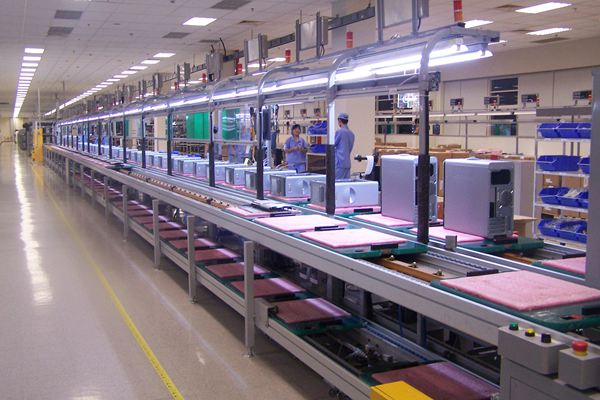
The image presents a sophisticated desktop computer assembly line—a purpose-built system engineered for the systematic integration of high-performance computing hardware. This facility exemplifies modern electronics manufacturing, where precision workstation design converges with progressive assembly methodology to achieve unwavering product quality and optimized throughput.
Visible system chassis, motherboards, and power supply units signify a complete integration process: transforming discrete subassemblies into fully functional computing platforms ready for deployment. The environment reflects the stringent demands of the consumer electronics and enterprise IT sectors, where rapid product evolution and zero-defect expectations necessitate adaptable yet relentlessly reliable production systems.
I. Structural Configuration: The Dual-Track Spine
The assembly line is anchored by a dual-track conveyor configuration, arranging multiple sequential workstations in a linear progression. This architecture follows established product-oriented layout principles, positioning each station precisely according to the required assembly sequence.
Modular Agility
The structural framework utilizes aluminum extrusion profiles with modular mounting capabilities. This enables rapid reconfiguration in response to product design changes or process optimization initiatives—critical in an industry defined by short life cycles. Overhead, integrated fluorescent arrays provide uniform illumination essential for precision electronics assembly.
Cleanroom-Grade Integrity
The elevated dual-track mechanism facilitates simultaneous processing of multiple units while maintaining ergonomic working heights. More importantly, the polished flooring and controlled lighting underscore a cleanroom-grade environment. In electronics manufacturing, particulate contamination poses a direct threat to circuit board reliability and connector integrity; this controlled atmosphere is the first line of defense against latent defects.
II. Workstation Design: ESD-Safe Ergonomics
Each workstation is a meticulously engineered ecosystem designed to protect sensitive components while maximizing operator productivity.
Static Control
Work surfaces are positioned between 750mm and 850mm, complying with ergonomic standards. Crucially, anti-static (ESD) matting is installed to protect sensitive electronics from electrostatic discharge. Grounding points and conductive surfaces are visibly integrated into the design, safeguarding delicate semiconductors from voltage-induced damage.
Optimized Motion
The open-front design provides unobstructed access to components and precision tools. An overhead gantry system supports integrated lighting and potential automated delivery mechanisms. Component bins and tool holders are strategically placed within the operator’s natural reach envelope, drastically reducing non-value-added motion. Spacing between stations is calculated based on takt time to ensure smooth workflow, while anti-fatigue measures support sustained concentration during repetitive tasks.
III. Assembly Process: The Logical Build
The transformation from components to a functional computing system follows a disciplined, logical sequence:
- Chassis Preparation: Mounting of drive bays, cooling system brackets, and cable management infrastructure.
- Core Integration: Mid-line stations handle motherboard installation, followed by the precise seating of CPUs, memory modules, and expansion cards.
- Subsystem Assembly: Sequential installation of power supply units, storage devices, and peripheral connectors.
- Thermal & Electrical Management: Cable routing through designated channels with standardized tie-downs ensures both electrical safety and optimal airflow.
The progressive nature of the line ensures that each operation is completed and verified before advancing, maintaining a clean build sequence essential for troubleshooting and quality assurance.
IV. Quality Control: Embedded Validation
Quality assurance is not a final hurdle but an embedded layer throughout the assembly process.
In-Process Verification
Every workstation incorporates visual inspection and functional verification. Critical parameters—component seating integrity, connector engagement depth, and torque specifications—are verified before the unit proceeds downstream.
Stress & Functional Testing
The final sections of the line feature rigorous validation protocols:
- Burn-In Testing: Systems are subjected to extended operational cycles under thermal stress to identify “infant mortality” failures.
- Comprehensive I/O Validation: Testing of all ports, storage subsystems, and network connectivity.
- BIOS & Firmware Verification: Ensuring configuration aligns with product specifications.
- Performance Stress Testing: Validating thermal management systems under peak processor and memory loads.
This integrated approach drastically reduces rework costs and ensures that only fully vetted units proceed to packaging.
V. Material Flow: Synchronized Logistics
The assembly line operates within a structured supply chain designed to synchronize component delivery with consumption rates.
Just-in-Time (JIT) Delivery
Components arrive in kit form or via sequenced delivery systems aligned with the Bill of Materials (BOM) for each station. The dual-track system allows for strategic buffer accumulation between operations of varying cycle times, absorbing minor variability without disrupting throughput.
Inventory Precision
Work-in-progress (WIP) levels are tightly controlled to minimize capital expenditure while maintaining buffers for supplier variability. JIT replenishment systems automatically trigger restocking when consumption hits predetermined thresholds, ensuring continuous flow without excessive clutter at the point of use.
VI. Production Capacity: Adaptive Scalability
The configuration is engineered for variable production volumes and mixed-model flexibility.
Dynamic Rebalancing
Staffing levels and operational shifts can be adjusted to meet demand. The modular design allows for rapid rebalancing; tasks can be reassigned or subdivided based on takt time analysis and workload distribution studies.
Mixed-Model Capability
The line supports concurrent assembly of diverse configurations—varying in processor type, memory capacity, storage architecture, and chassis form factor. Changeover procedures between product variants are streamlined through standardized tooling and documented protocols, minimizing transition time. This agility is paramount in the computer manufacturing industry, where rapid technological advancement and diverse customer requirements demand highly responsive production capabilities.
Conclusion
This computer assembly line represents a well-engineered system that masterfully balances efficiency, quality, and ergonomics within the demanding context of electronics manufacturing. The dual-track configuration provides a structured environment for consistent assembly, while the modular design supports continuous improvement and rapid product evolution.
By embedding quality verification at multiple stages, the system ensures the reliable performance essential for computing equipment where data integrity and system uptime are paramount. As manufacturing technology advances, such lines remain foundational in the electronics industry—adaptable, precise, and resilient. They stand as a testament to the modern industrial approach: a seamless concert between skilled human craftsmanship, systematic process control, and rigorous ESD protection protocols, delivering products that meet the highest standards of performance, reliability, and user satisfaction.