Product Categories
PRODUCT CATEGORYContact Us
CONTACT USMobile phone:+86-15395152932
mail:sale@assyauto.com
Address:Electronic Information Industrial Park, Shunyi District, Beijing City
How to choose high-output wall-hung boiler assembly line?
Wall-Hung Boiler Assembly Line A Comprehensive Overview of Production Engineering
The Manufacturing Environment
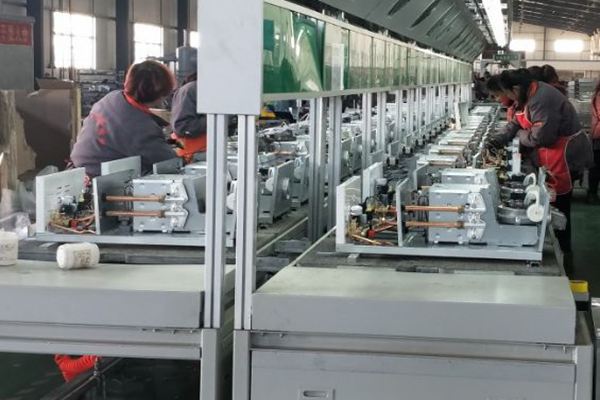
The image captures a modern wall-hung boiler assembly line—a purpose-built system for the systematic manufacturing of residential and commercial heating equipment. This production floor exemplifies contemporary industrial engineering, balancing ergonomic workstation design with sequential assembly methodology to achieve unwavering product quality and operational efficiency.
Visible copper piping, gas valve assemblies, and electronic control housings indicate that this line handles the complete integration of combi-boiler units, merging heating and domestic hot water functions within a single, compact chassis. It represents a medium-to-high volume configuration typical of the HVAC industry, where standardized processes are non-negotiable for meeting market demand while adhering to stringent safety and performance standards.
I. Structural Configuration: The Linear Spine
The assembly line is anchored by a linear conveyor-based configuration, arranging multiple sequential workstations in a straight-line progression. This follows the classic product-oriented layout principle, positioning stations precisely according to the assembly sequence required to complete the finished product.
Modular Framework
The structural backbone utilizes aluminum extrusion profiles with modular mounting capabilities. This design provides the flexibility necessary for equipment reconfiguration and process optimization without major downtime. Overhead, integrated lighting and ventilation systems ensure adequate illumination and air quality—critical for precision assembly tasks involving gas and electrical components.
Ergonomic Elevation
The elevated conveyor mechanism is a deliberate design choice. By positioning the product at an optimal working height, it minimizes operator fatigue during repetitive assembly cycles. Protective side panels and backboards serve a dual purpose: providing structural rigidity to the workstation framework while containing components and tools within defined zones, effectively reducing the risk of foreign object contamination.
II. Workstation Design: Precision and Comfort
Each workstation is engineered as a self-contained ecosystem tailored to specific assembly operations while prioritizing operator well-being.
Ergonomic Standards
Work surfaces adhere to industrial ergonomic guidelines, positioned between 750mm and 850mm depending on the task. The open-front design grants operators unobstructed access, while side panels offer necessary protection. Component bins and tool holders are strategically placed within the operator’s natural reach envelope, drastically reducing non-value-added motion and improving cycle time consistency.
Environmental Support
Spacing between stations is calculated based on takt time and operational complexity to prevent bottlenecks. Anti-fatigue matting is standard at standing workstations to mitigate physical strain during extended shifts. For operations requiring sustained precision, adjustable seating is provided, acknowledging that human comfort directly correlates with product quality.
III. Assembly Process: The Logical Progression
The transformation from loose components to a fully functional heating unit follows a disciplined sequence:
- Foundation Stage: Preparation of the main chassis, mounting of the heat exchanger housing, combustion chamber, and water circuit manifolds.
- Hydraulic Integration: Connection of copper piping assemblies to the hydraulic circuit. This requires strict adherence to torque specifications and immediate leak-testing protocols.
- Mechanical & Electrical Fit: Installation of gas valve assemblies, burner units, ignition systems, and electronic control modules.
- Enclosure & Routing: A logical progression from internal components to external housings. Wiring harnesses are routed through designated channels, and standardized fasteners secure all connection points to ensure long-term electrical safety and reliability.
The progressive nature of the line ensures that each operation is completed and verified before the unit advances, maintaining a clean and logical build sequence.
IV. Quality Control: Embedded Assurance
Quality assurance is not a terminal checkpoint but an embedded layer throughout the assembly process.
In-Process Verification
Every workstation incorporates visual inspection and functional verification relevant to the task at hand. Critical parameters—pipe connection torque, electrical continuity, and component alignment—are verified before the unit proceeds downstream.
Terminal Testing
The final sections of the line feature rigorous validation protocols:
- Pressure Testing: The hydraulic circuit is subjected to elevated pressure to validate joint integrity.
- Combustion Analysis: Verification that air-to-fuel ratios meet regulatory requirements for efficiency and emissions.
- Electronic Diagnostics: Functional testing of control boards to ensure safety interlocks, temperature sensors, and user interfaces operate within specifications.
- Gas Tightness: Calibrated pressure decay methods confirm system integrity.
This integrated approach significantly reduces rework costs and ensures that non-conforming units are identified and rectified before completion.
V. Material Flow & Logistics: The Synchronized Supply
The assembly line operates within a structured material supply system designed to synchronize component delivery with production consumption.
Just-in-Time Delivery
Components are supplied in kit form or through sequenced delivery systems aligned with the Bill of Materials (BOM) for each station. The linear configuration supports efficient material delivery along the line perimeter, with supply routes carefully designed to avoid interference with operator work zones.
Inventory Management
Work-in-progress (WIP) levels are tightly controlled to minimize capital tied up in inventory while maintaining sufficient buffer to absorb minor operational variations. Kanban-based replenishment systems trigger component restocking automatically when consumption reaches predetermined thresholds, ensuring continuous flow without excessive clutter at the point of use.
VI. Production Capacity & Flexibility: Adaptive Manufacturing
The configuration supports variable production volumes through adjustments in staffing levels and operational shifts.
Modular Rebalancing
The modular workstation design allows for rapid rebalancing of operations in response to product design changes or efficiency optimizations. Multiple operators can be assigned to high-content stations, or tasks can be combined/subdivided based on takt time analysis.
Mixed-Model Capability
The line is engineered for mixed-model production, enabling the assembly of different boiler models—varying in capacity, control systems, or market-specific configurations—within the same production flow. Changeover procedures between product variants are streamlined through standardized tooling and documented setup protocols, minimizing transition time. This flexibility is vital in the HVAC industry, where seasonal demand fluctuations and regional market variations require highly responsive manufacturing capabilities.
Conclusion
This wall-hung boiler assembly line represents a well-engineered manufacturing system where production efficiency, product quality, and operator ergonomics exist in equilibrium. The linear conveyor configuration provides a structured environment for consistent assembly, while the modular design supports continuous improvement and product evolution.
By embedding quality verification at multiple stages, the system ensures the reliable performance essential for heating equipment where safety and durability are paramount. As manufacturing technology advances, such lines remain the foundational production systems in the HVAC industry—adaptable, precise, and resilient. They stand as a testament to the modern industrial approach: a seamless concert between skilled human craftsmanship and engineered process control, delivering products that meet the highest standards of performance and reliability.